
Discover the complete guide to School ERP Software in 2025: Features, Benefits & Pricing
Why Every School Needs ERP in 2025
Running a school is no longer limited to managing classrooms and examinations. In 2025, institutions handle admissions, fee collection, compliance, online classes, digital communication, security, and even analytics.
Traditional methods — registers, manual paperwork, and spreadsheets — are not just time-consuming, they also slow down decision-making, cause errors, and frustrate staff, parents, and students alike.
This is why School ERP software has become a necessity. A robust ERP brings all school processes together in a single, centralized platform. From fee management to attendance tracking, exam reports to communication, everything happens seamlessly.
In this comprehensive guide, you’ll learn:
-
What School ERP is and why it matters.
-
Features & benefits of modern ERP solutions.
-
How ERP helps both small and large institutions.
-
Security, compliance, and real-world case studies.
-
Cloud vs on-premise ERP systems.
-
Pricing, ROI, and future trends in 2025.
By the end, you’ll know exactly how a School ERP can transform your institution — and why UDT eSchool is a leading choice.
Related: SAFAL Exam 2025 Updated Guide for Class 6 and 9
What is School ERP Software?
School ERP (Enterprise Resource Planning) software is a comprehensive digital platform designed to automate, streamline, and centralize all the core operations of an educational institution. Instead of relying on manual processes, paperwork, or disconnected tools, schools can use ERP to manage everything under one umbrella — from student admissions to fees, attendance, exams, and parent communication.
Think of it as the digital nervous system of a school, connecting administrators, teachers, students, and parents in one seamless ecosystem.
Key Functions of School ERP
-
Administration: Admission management, student records, HR, and payroll.
-
Academics: Timetables, lesson planning, exam management, and grading.
-
Finance: Fee collection, online payments, accounts, and budget reports.
-
Communication: Parent-teacher messaging, notifications, circulars, and SMS/email updates.
-
Data Security: Secure storage of sensitive student and staff data with encryption.
-
Mobility: Mobile apps for teachers, students, and parents for real-time updates.
Why It Matters in 2025
The education sector is undergoing rapid digital transformation. With online classes, hybrid learning, and increased parental involvement, schools can no longer rely on outdated methods. School ERP software ensures:
-
Transparency: Parents and management stay updated in real time.
-
Efficiency: Teachers spend less time on admin work, more on teaching.
-
Scalability: Works equally well for small schools or large institutions.
-
Compliance: Supports board-specific report formats (CBSE, ICSE, State Boards).
In short, School ERP is not just a software—it’s a strategic tool that future-proofs institutions for the next decade.
⚙️ Core Features of School ERP Software (2025 Edition)
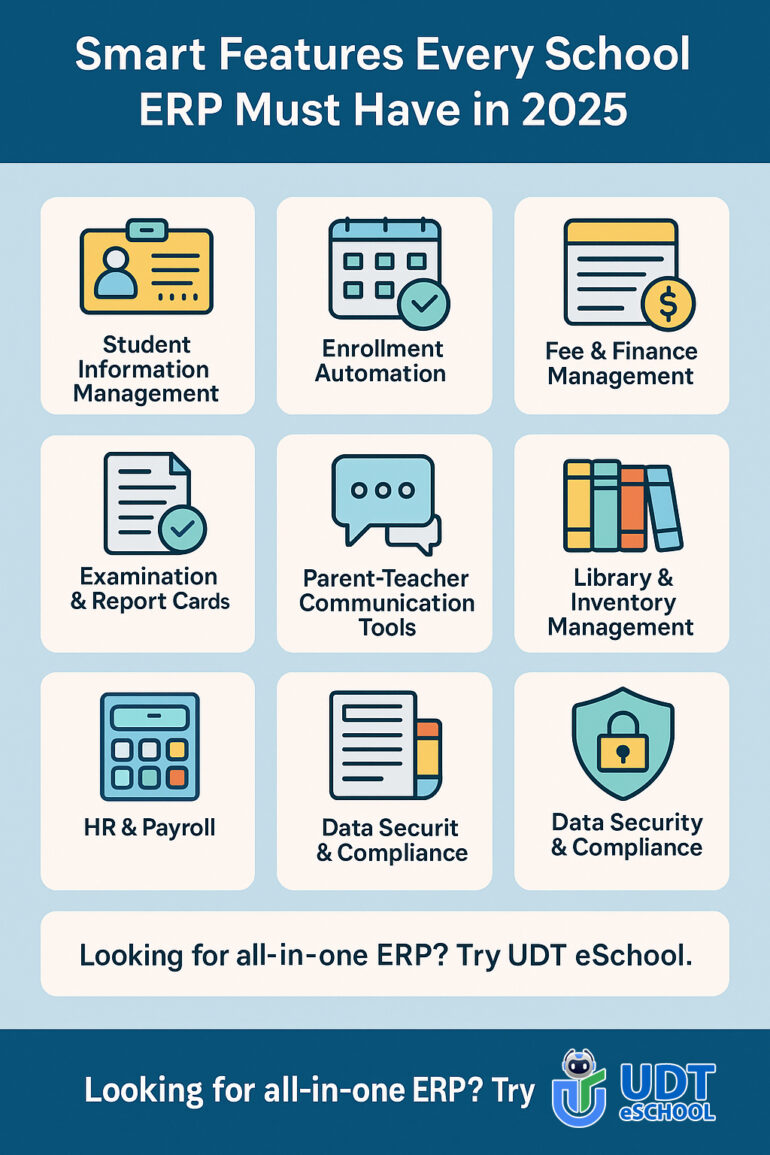
Modern School ERP systems have evolved beyond just fee collection or attendance tracking. In 2025, schools demand end-to-end digital solutions that cover academics, finance, communication, compliance, and security.
Here’s a detailed breakdown of the must-have features in a School ERP software:
Student Information Management
-
Stores complete student records (admission, personal details, academic history).
-
Tracks transfers, achievements, and disciplinary records.
-
One-click access to student profiles for teachers and administrators.
Benefit: Saves time on administrative work and reduces data duplication.
Admission & Enrollment Automation
-
Online registration forms with document uploads.
-
Automated merit lists and seat allocation.
-
Digital fee collection during admission.
Benefit: Speeds up admission cycles, eliminates long queues, and improves parent experience.
Attendance Management
-
Biometric, RFID, and mobile app-based attendance.
-
Automatic syncing with student/parent portals.
-
Detailed daily, monthly, and yearly reports.
Benefit: No manual registers, zero errors, and real-time updates to parents.
Fee & Finance Management
-
Multiple payment gateways for parents.
-
Auto-generated receipts and invoice tracking.
-
Integrates with accounting systems for budgeting.
Benefit: Ensures transparency, reduces defaults, and simplifies audits.
Timetable & Scheduling
-
AI-driven timetable generation to avoid clashes.
-
Automatic substitution in case of teacher absence.
-
Custom timetables for classes, teachers, and labs.
Benefit: Smooth academic planning without last-minute disruptions.
Examination & Report Cards
-
Online exam scheduling and grading.
-
Board-compliant report card formats (CBSE, ICSE, State Boards).
-
Instant publishing of results to parent apps.
Benefit: Saves hours of teacher workload and ensures error-free grading.
Parent-Teacher Communication Tools
-
Push notifications, SMS, and email alerts.
-
Digital circulars and announcements.
-
Two-way parent-teacher messaging.
Benefit: Builds stronger school-parent relationships and increases trust.
Library & Inventory Management
-
Digital cataloging of books and resources.
-
Automated issue/return tracking with QR or RFID.
-
Stock management for uniforms, lab equipment, etc.
Benefit: Reduces losses and improves resource utilization.
HR & Payroll
-
Employee records management.
-
Automated payroll with tax and PF/ESI deductions.
-
Leave and attendance integration for staff.
Benefit: Simplifies HR operations and ensures timely, error-free salary processing.
Data Security & Compliance
-
End-to-end encryption for sensitive data.
-
Multi-factor authentication (MFA).
-
Automated backups and role-based access control (RBAC).
Benefit: Protects student privacy and ensures compliance with data protection laws.
Related: PARAKH Competency-Based Report Card Guide
Benefits of School ERP Software for Institutions
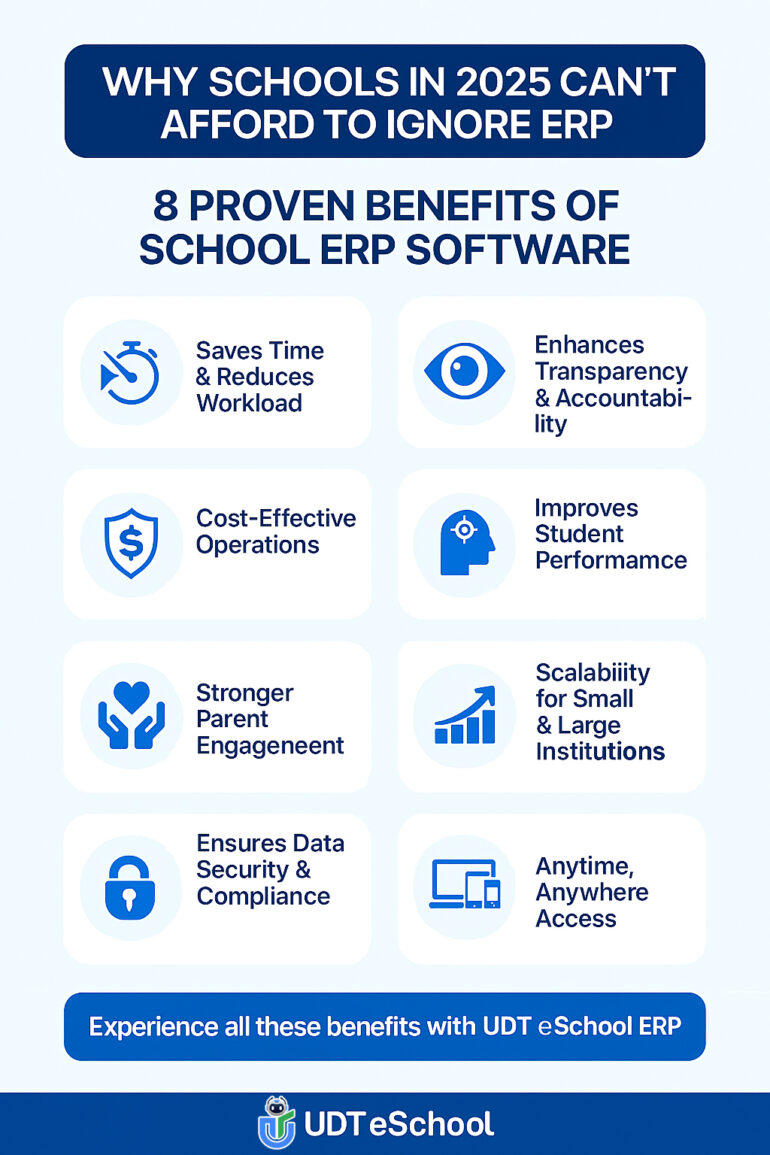
While features explain what the ERP does, benefits explain why schools actually need it. A well-implemented School ERP system delivers measurable improvements in efficiency, transparency, and academic outcomes.
Here are the key benefits of School ERP software in 2025:
1. Saves Time & Reduces Workload
Teachers and administrators spend hours on repetitive tasks like attendance, fee collection, and report generation. ERP automates these, freeing staff to focus on teaching and student development.
2. Enhances Transparency & Accountability
Parents receive instant updates on attendance, performance, and fees. Management can monitor every department in real time. This builds trust and reduces miscommunication.
3. Cost-Effective Operations
Digitization reduces paperwork, manual errors, and administrative overheads. Schools save on printing, storage, and staffing costs while improving efficiency.
4. Improves Student Performance
With auto-generated progress reports, timely feedback, and easy access to learning resources, students get personalized attention that directly impacts their academic growth.
5. Stronger Parent Engagement
Parents no longer have to wait for PTMs to know about their child’s progress. Notifications, fee reminders, and academic updates keep them engaged daily.
6. Ensures Data Security & Compliance
ERP solutions use encryption, backups, and secure logins to safeguard sensitive student and financial data. This protects schools from data breaches and regulatory penalties.
7. Scalability for Small & Large Institutions
Whether a school has 300 students or 30,000, ERP adapts easily. Schools can add modules as they grow, without replacing the entire system.
8. Anytime, Anywhere Access
Cloud-based ERP allows administrators, teachers, parents, and students to log in from mobile or desktop anytime. This is crucial for hybrid or remote learning setups.
Schools implementing ERP report 30–40% time savings in administrative work and significantly higher parent satisfaction.
Related: SAFAL Exam assessment framework
School ERP for Small vs Large Institutions
Not all schools have the same needs.
-
Small Schools (up to 1000 students):
-
Need cost-effective, easy-to-use ERP.
-
Focus on essentials: fees, attendance, and reports.
-
-
Large Schools & Colleges (2000+ students):
-
Require scalability and custom modules.
-
Advanced reporting, integrations (HR, finance, transport).
-
Multi-campus or branch support.
-
Read our detailed blog: School ERP for Small vs Large Institutions
Data Security in School ERP
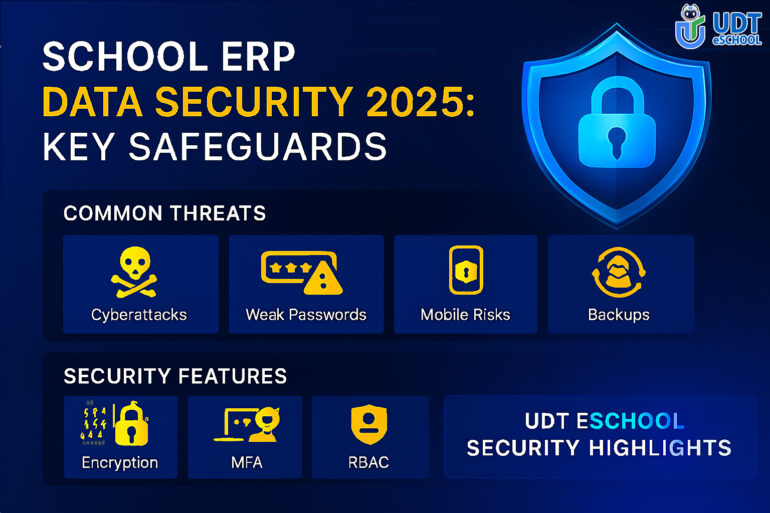
Schools hold sensitive data — student records, staff payroll, financial details. A breach can cause serious legal and reputational damage.
A secure ERP ensures:
-
Data encryption → protects information in transit and storage.
-
Multi-factor authentication (MFA) → prevents unauthorized access.
-
Regular backups → ensures data recovery during disasters.
-
Role-based access → staff see only what they need.
Explore our blog: School ERP Data Security 2025
Compliance Across Boards (CBSE, ICSE, State)
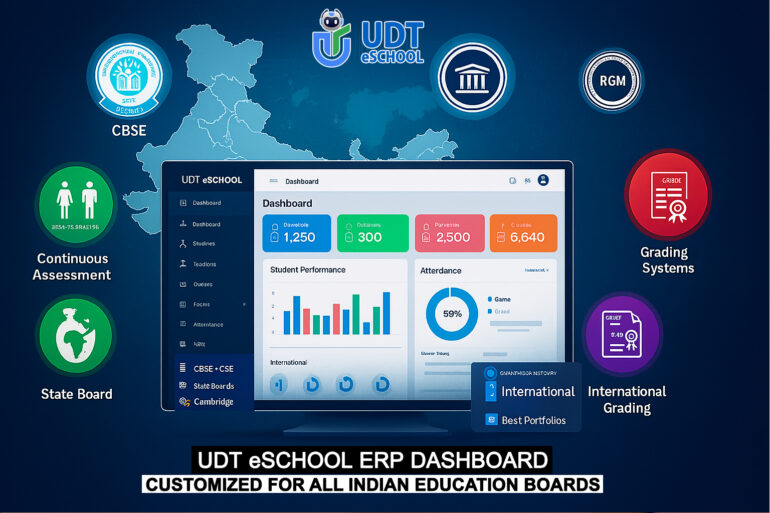
Each education board in India has unique requirements:
-
CBSE: Requires CCE reports, standardized grade sheets, and specific exam formats.
-
ICSE: Has complex timetables, diverse subjects, and detailed reporting structures.
-
State Boards: Demand localized reports and compliance with regional education laws.
A good ERP adapts to all board-specific requirements, saving schools the hassle of manual formatting.
Read more: School ERP Compliance Across Boards
Case Study: Real School ERP Implementation

A convent school in India faced challenges with delayed fee payments, paper-based attendance, and weak communication.
Before ERP:
-
20+ hours wasted weekly on manual data entry.
-
Frequent errors in fee collection.
-
Parents unaware of student performance.
After ERP Implementation:
-
Online fee collection increased on-time payments by 70%.
-
Attendance tracking reduced errors to almost zero.
-
Parents received real-time updates via mobile app.
See full case study: A Convent School ERP Journey – Before vs After
☁️ Cloud vs On-Premise School ERP
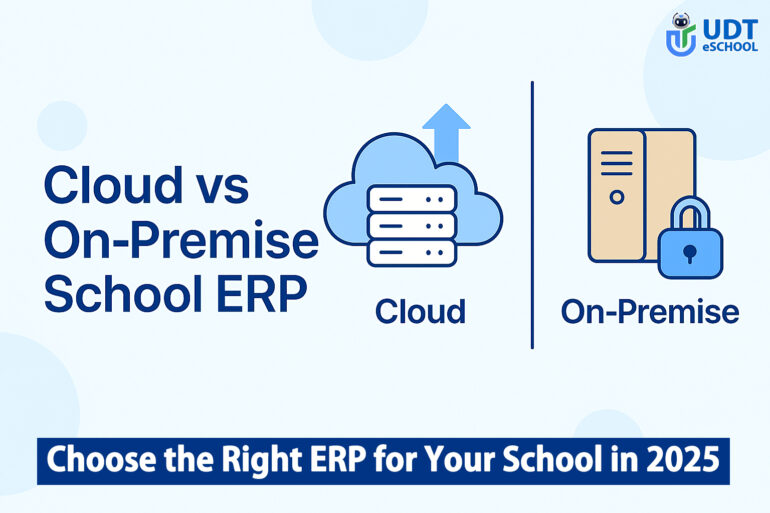
Choosing between cloud-based and on-premise ERP depends on budget, scale, and IT resources.
Cloud ERP
✅ Access anywhere, anytime.
✅ Lower upfront costs.
✅ Automatic updates and backups.
✅ Scales easily with student strength.
On-Premise ERP
✅ Greater control over hardware and servers.
✅ One-time license purchase.
❌ Requires dedicated IT staff for maintenance.
❌ High upfront investment.
In 2025, cloud ERP dominates due to affordability and convenience.
Challenges Schools Face Without ERP
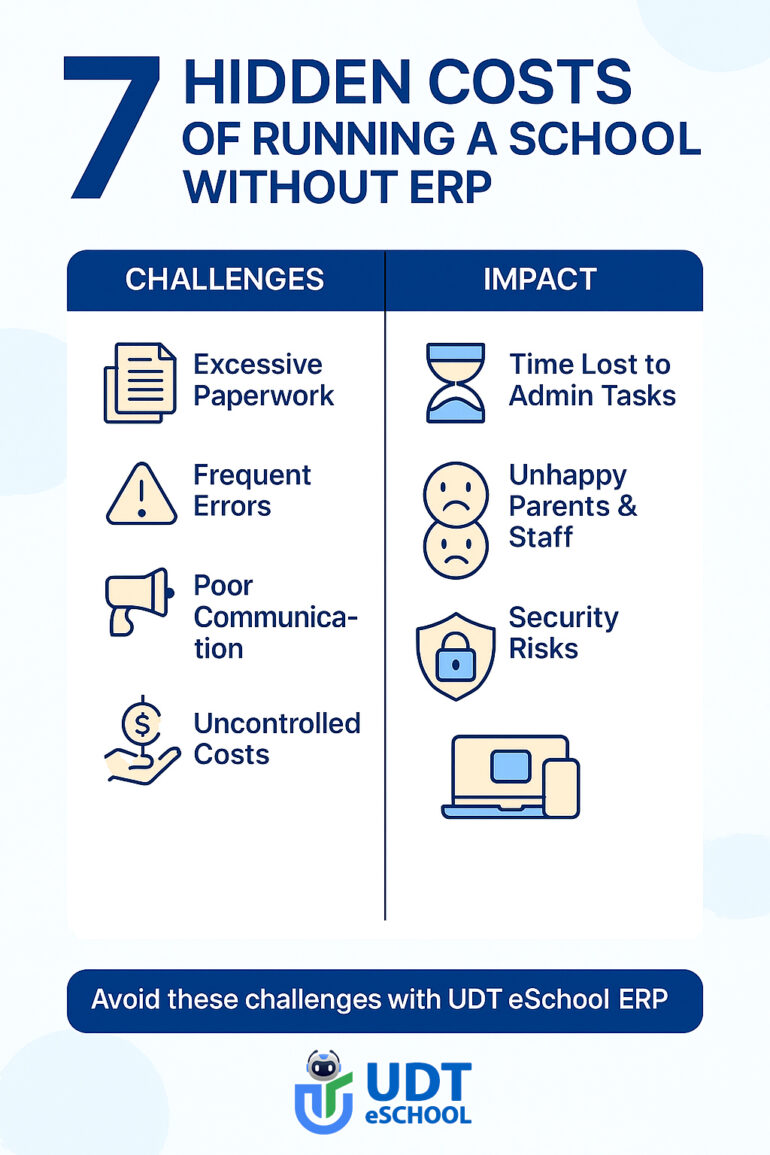
Many schools still rely on traditional methods — registers, paper files, manual accounts, or disconnected software. While these might “work” on the surface, they create hidden inefficiencies that grow over time.
Here are the biggest struggles schools face without an ERP system:
1. Time-Consuming Administrative Work
Manual attendance registers, handwritten report cards, and cash-based fee collection consume hours of teacher and admin time. This reduces focus on academics and lowers productivity.
2. Human Errors & Data Inaccuracy
Mistakes in fee records, attendance, or exam results are common when done manually. Even a small error can create frustration among parents and compliance issues for the school.
3. Poor Parent Communication
Parents often remain unaware of attendance shortfalls, upcoming exams, or fee dues until it’s too late. Without ERP notifications, schools face complaints and dissatisfaction from parents.
4. High Operational Costs
From paper registers to physical storage, manual processes drain money. Staffing costs also increase since more people are required to handle routine tasks.
5. Limited Transparency for Management
Principals and trustees often lack a real-time view of school performance. Without ERP dashboards, they depend on delayed or inaccurate reports, making decision-making difficult.
6. Security & Compliance Risks
Physical files and basic spreadsheets are prone to loss, theft, or misuse. Without ERP security features, schools risk data breaches, lost records, and non-compliance with education boards.
7. Scalability Challenges
As schools expand, manual processes fail. Handling thousands of students across multiple branches becomes impossible without a centralized ERP system.
✅ In short, schools that avoid ERP face inefficiency, rising costs, poor communication, and higher risks.
How to Choose the Right School ERP Software
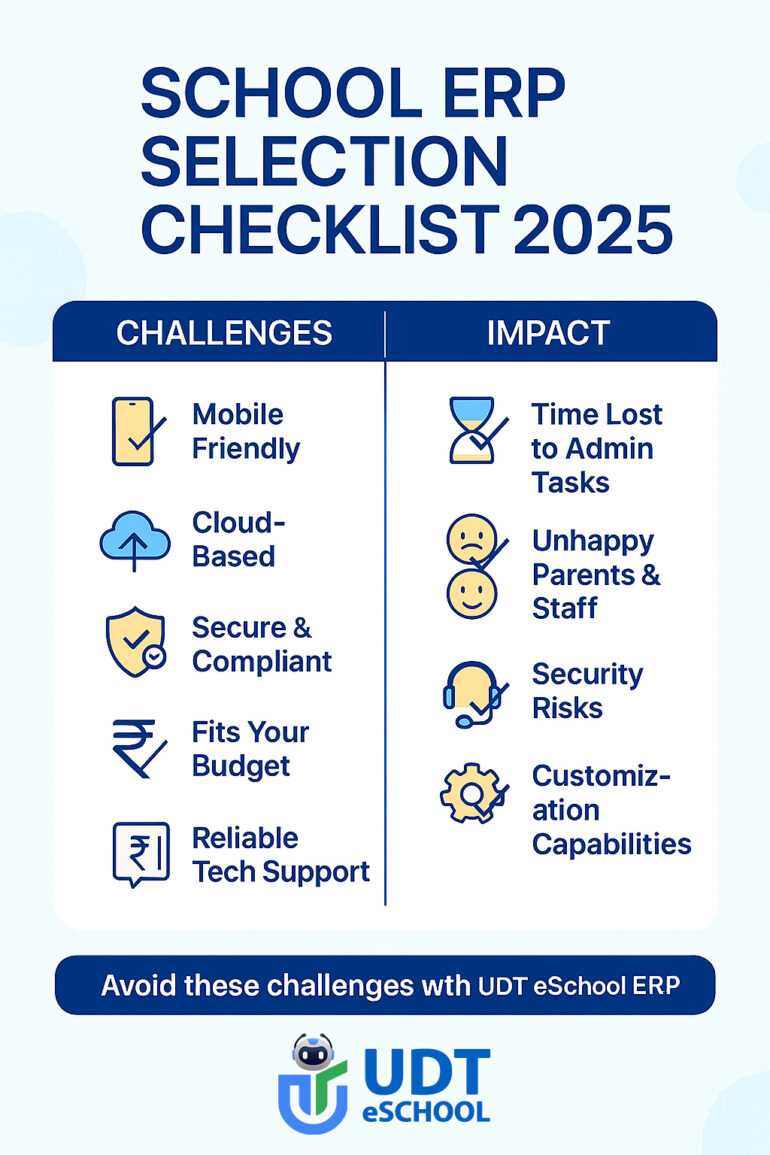
With so many School ERP providers in the market, selecting the right one can feel overwhelming. The wrong choice leads to wasted investment, frustrated staff, and poor adoption. To avoid these mistakes, schools should follow a clear checklist before deciding.
1. Define Your School’s Needs First
-
Small schools may prioritize affordable pricing and ease of use.
-
Large institutions may need advanced modules and scalability.
-
Decide which areas (fees, exams, communication, HR) need automation immediately.
Tip: Start with essential modules and expand later.
2. Check for Mobile Accessibility
-
Parents and teachers expect mobile apps for real-time updates.
-
A good ERP should work on Android, iOS, and web without glitches.
3. Evaluate Integration Capabilities
-
Can the ERP integrate with accounting software, HR systems, or LMS?
-
Look for APIs that allow customization and future expansion.
4. Assess Data Security
-
Ensure encryption, backups, and role-based access controls (RBAC).
-
Check compliance with data protection laws in your region.
5. Understand the Pricing Model
-
Some ERPs charge a flat annual fee, while others use a per-student model.
-
Compare total cost of ownership (TCO), including setup, training, and support.
6. Demand Reliable Customer Support
-
Implementation is only the first step — continuous support is crucial.
-
Look for 24/7 helpdesk, training sessions, and quick response times.
7. Ask About Customization & Scalability
-
Can the ERP adapt to your school’s unique needs?
-
Does it scale smoothly when student strength or branches grow?
✅ Quick Checklist: 7 Questions to Ask Before Buying School ERP
-
Is it scalable for future growth?
-
Does it support mobile apps for parents and teachers?
-
Can it integrate with existing systems?
-
How strong is the data security?
-
What is the pricing model — per student or flat fee?
-
What level of support and training is included?
-
Is the solution customizable for your school’s needs?
✅ Why UDT eSchool Fits the Bill:
-
Affordable and scalable for both small & large schools.
-
Mobile-first approach with Android/iOS apps.
-
Strong focus on security and compliance.
-
Dedicated customer support with quick onboarding.
School ERP Pricing Models Explained
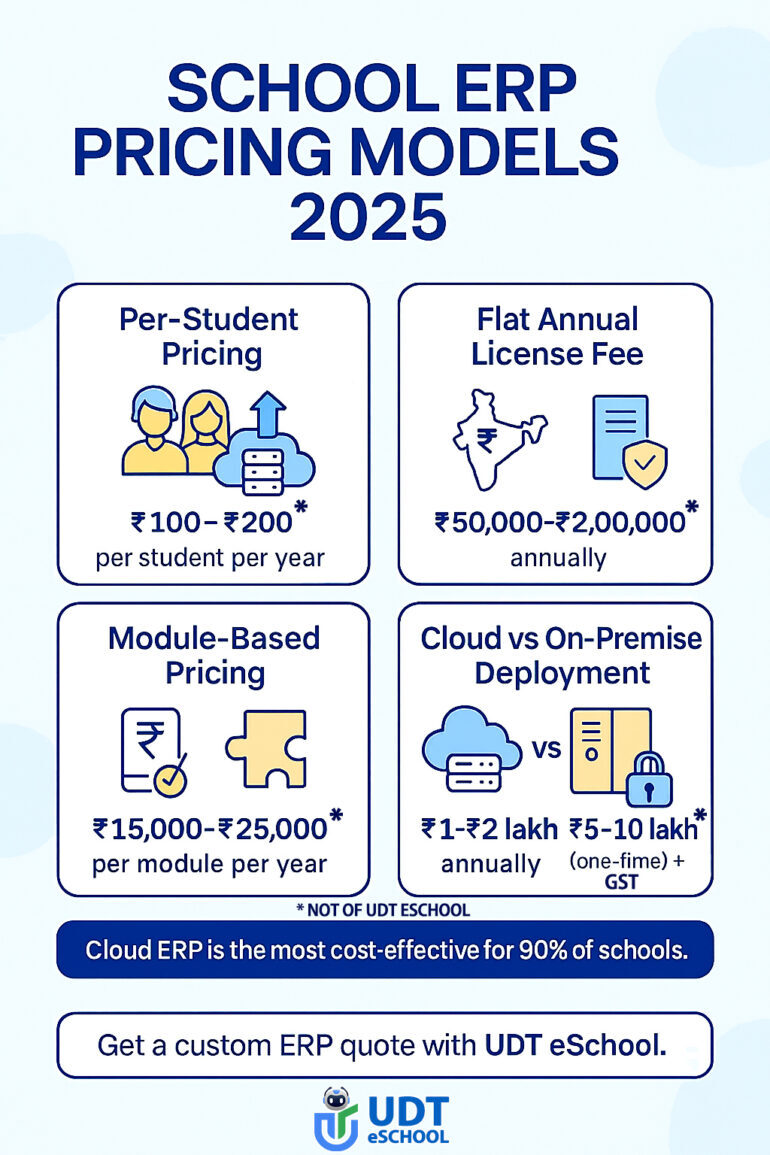
When evaluating School ERP solutions, pricing is often a deciding factor. But not all vendors follow the same model — costs vary depending on features, student strength, and deployment type (cloud or on-premise).
Here are the common pricing models schools will come across in 2025:
1. Per-Student Pricing
-
How it works: The school pays a fixed amount per student, per month or per year.
-
Example: ₹100–₹200 per student per year.
-
Best for: Small and medium schools that want flexibility and scalability.
-
Benefit: Schools only pay for actual usage, making it cost-efficient.
2. Flat Annual License Fee
-
How it works: One fixed annual fee for unlimited students (within defined limits).
-
Example: ₹50,000–₹2,00,000 annually depending on features.
-
Best for: Large institutions with thousands of students.
-
Benefit: Predictable costs with no per-student fluctuations.
3. Module-Based Pricing
-
How it works: Schools pay only for selected modules (e.g., Fee Management, Exams, HR).
-
Example: ₹15,000–₹25,000 per module per year.
-
Best for: Schools that want to start small and expand later.
-
Benefit: Affordable entry point with flexibility to add modules as needed.
4. Cloud vs On-Premise Deployment
-
Cloud ERP (Subscription Model):
-
No heavy hardware investment.
-
Automatic updates and 24/7 access.
-
Subscription-based (monthly/annual).
-
Average cost: ₹1–₹2 lakh annually depending on student size.
-
-
On-Premise ERP (One-Time License + AMC):
-
One-time high license cost + server setup.
-
Annual Maintenance Charges (AMC) for updates.
-
Schools handle IT infrastructure.
-
Average cost: ₹5–₹10 lakh (one-time) + 10–15% AMC annually.
-
5. Hidden Costs to Watch For
-
Setup and installation charges.
-
Staff training sessions.
-
Customization fees.
-
SMS/notification credits.
Example: A 1000-student school might pay ₹50–₹150 per student annually — much less than the cost of additional admin staff.
Return on Investment (ROI):
-
Saves staff time and salaries.
-
Increases fee collection efficiency.
-
Reduces printing and stationery costs.
-
Enhances parent satisfaction → better admissions.
✅ Pro Tip: Always calculate the Total Cost of Ownership (TCO), not just the license cost. TCO includes subscription, support, customization, training, and future upgrades.
Future of School ERP (2025 & Beyond)
ERP systems are becoming smarter and more adaptive.
-
AI-powered analytics → predicts student outcomes, identifies weak areas.
-
Integration with EdTech tools → online classes, digital payments, government portals.
-
Personalized learning insights → supports adaptive teaching methods.
-
Blockchain in ERP → for tamper-proof records and certificates.
The future is smart, integrated, and data-driven. Schools adopting ERP today will be ahead of the curve.
Why UDT eSchool is the Right Choice
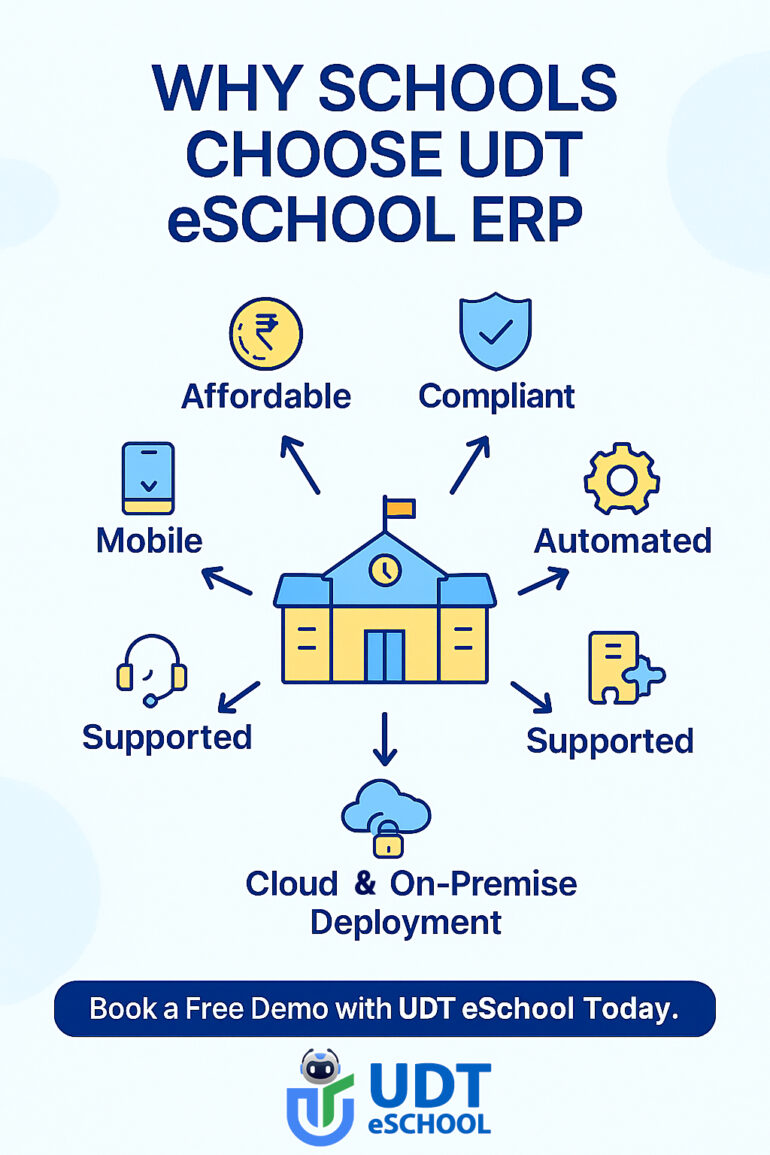
After understanding features, benefits, challenges, and pricing, schools often ask: “Which ERP should we choose?” That’s where UDT eSchool emerges as the smart choice for Indian institutions.
Here’s what makes UDT eSchool different:
1. Tailored for Indian Schools
Unlike generic ERPs, UDT eSchool is built specifically for Indian education boards (CBSE, ICSE, State Boards) with compliant report formats and exam structures.
2. Affordable & Transparent Pricing
-
No hidden costs, no unnecessary upselling.
-
Options for per-student and flat license models.
-
Flexible pricing for small, medium, and large institutions.
3. Mobile-First Approach
-
Android & iOS apps for parents, teachers, and students.
-
Push notifications for fees, results, attendance, and circulars.
-
Anytime, anywhere access — even in rural areas with limited bandwidth.
4. End-to-End Automation
From admissions to payroll, everything is covered under one platform. Schools don’t need to juggle multiple software or vendors.
5. Strong Data Security
-
End-to-end encryption for student and financial data.
-
Multi-factor authentication and secure cloud hosting.
-
Automated backups to prevent data loss.
6. Dedicated Support & Training
-
24/7 support with quick response times.
-
Onboarding and training for teachers and admins.
-
Smooth transition from manual processes to ERP without disruptions.
7. Proven Track Record
-
Successfully implemented across multiple schools and institutions.
-
Case studies show reduced admin workload and improved parent satisfaction.
✅ In short: UDT eSchool combines affordability, scalability, and reliability — making it the go-to ERP for schools that want growth without complexity.
Related: AI-Powered ERP for CBSE Schools
Conclusion: The Future of School ERP in 2025
The education sector is evolving rapidly, and schools can no longer rely on outdated manual systems. A modern School ERP solution is no longer a luxury — it’s a necessity for smooth operations, better parent engagement, and long-term growth.
By now, you’ve seen:
-
What School ERP is and how it works.
-
Key features that simplify school administration.
-
Benefits for management, teachers, parents, and students.
-
Challenges schools face and how ERP solves them.
-
Detailed insights into ERP pricing models.
The next step for any institution is clear — choose a reliable, future-ready ERP that is affordable, easy to use, and secure.
That’s exactly where UDT eSchool ERP stands out.
With affordable pricing, mobile-first access, data security, and complete automation, UDT eSchool ensures schools save time, cut costs, and focus on what truly matters — quality education.
Take the Next Step with UDT eSchool
-
✅ Book a Free Demo and explore the platform.
-
✅ Get a custom pricing quote for your institution.
-
✅ Start your journey towards smarter school management.
❓ Frequently Asked Questions – FAQ

Your top questions about AI-driven ERP, Answered
Q1. What is School ERP software?
A School ERP (Enterprise Resource Planning) software is a digital platform that automates school operations such as admissions, fee collection, timetable scheduling, attendance, exams, HR, and communication with parents. It centralizes all academic and administrative tasks to save time, reduce errors, and improve efficiency.
Q2. Why do schools need ERP software?
Schools need ERP software to replace outdated manual processes with automation. It helps in managing large amounts of student and financial data, ensures transparency with parents, improves teacher productivity, reduces paperwork, and supports online learning integrations.
Q3. How much does School ERP cost in India?
The cost of School ERP in India depends on factors like student strength, features, and deployment type (cloud vs on-premise). On average, it ranges from ₹100–₹200 per student annually (cloud-based) to ₹5–₹10 lakh for a one-time on-premise license with additional maintenance charges.
Q4. What are the benefits of cloud-based School ERP?
Cloud-based School ERP offers:
-
24/7 access from anywhere.
-
No heavy investment in hardware.
-
Automatic software updates.
-
Enhanced data security and backups.
It is the most cost-effective and flexible option for most schools.
Q5. Is School ERP suitable for small schools?
Yes. Modern School ERP solutions are scalable and affordable for small schools. They can start with basic modules like admissions, fees, and attendance, and later expand to advanced features like HR, transport, and library management as they grow.
Q6. Which is the best School ERP software in 2025?
The best School ERP software is one that offers affordable pricing, strong security, mobile access, and comprehensive features. UDT eSchool is one of the most trusted ERP platforms for Indian schools, supporting CBSE, ICSE, and State Board institutions with end-to-end automation.
Q7. How can I get a demo of UDT eSchool ERP?
You can easily request a free demo by visiting the official website: Book a Demo Here
✅ Call to Action
The future of education is AI-powered and digitally driven. With CBSE reforms around the corner, UDT eSchool ERP ensures schools don’t just adapt but lead the transformation.
Transform your institution with UDT eSchool — a secure, scalable, and affordable School ERP solution.
✅ Book a Free Demo of UDT eSchool – India’s 1st AI-Powered School ERP
If you’re looking for the best AI-powered ERP for your school, UDT eSchool is the answer.
✅ Switch to UDT eSchool Today!
The #1 AI-Powered School ERP with Smart Attendance, Predictive Analytics & Full Automation.


